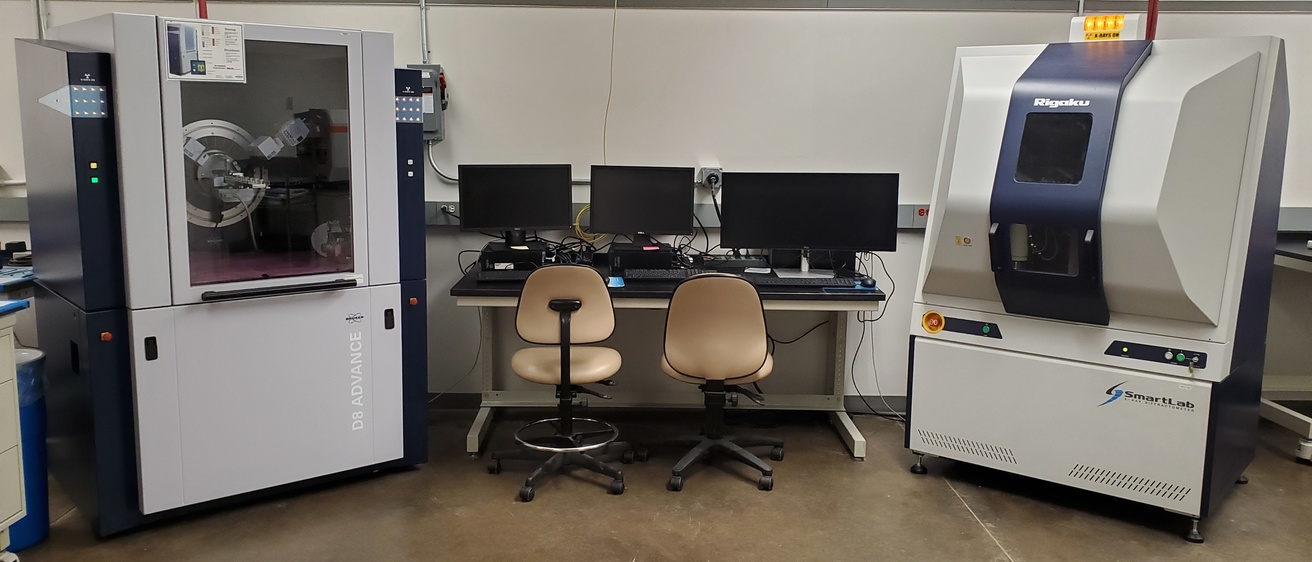
Bruker D8 and Rigaku Smart Lab Diffractometers
Bambu Lab X1E 3D Printer
The powder X-ray diffraction instrumentation in the facility is designed to analyze polycrystalline materials. For the analysis of powders, the Bruker D8 Advance diffractometer is the preferred instrument. This instrument is equipped with a standard Cu source, variable slits (for Bragg-Brentano beam geometry) or Göbel mirrors (for parallel-beam geometry), and a LynxEye position-sensitive solid-state detector for high-speed data collection.
The second PXRD instrument in the facility is a Rigaku SmartLab. This instrument is designated to analyze both powder and non-powder crystalline samples (films, metals, rocks, etc.). This instrument is also equipped with a standard Cu source, variable slits (for Bragg-Brentano beam geometry) or Cross Beam Optics (for parallel beam geometry), and a D/teX position-sensitive solid-state detector. With a variable Z-axis on this instrument, materials up to 30 mm in height can be placed on a flat holder for surface analysis.
For PXRD data analysis, the facility maintains a license for the ICDD PDF 4+ powder diffraction database along with analysis software Jade, Eva, and Topas.
Quick Info Box
- Location: IATL 196
- X-ray Source: Cu Kalpha radiation
- # of samples for automated collection: 1 - 9
- Particle sizes: nm to 20 micron (for best results)
- Managers: Michael Sinnwell, Nicholas Dahlen
- Contact: matfab-staff@uiowa.edu
APPLICATIONS
- Phase identification and quantification of minerals, ceramics, metals, pharmaceuticals, dental materials, and other crystalline materials
- Materials characterization and quality control, including phase purity, detection of impurities and secondary phases, crystallite size and strain analysis, and evaluation of structural changes resulting from synthesis, heat treatment, processing, or service conditions
- Mixed-phase and environmental materials characterization, including analysis of soils, sediments, corrosion products, and complex mineral mixtures to identify and quantify constituent crystalline phases
- Phase transitions and structural changes, including effects of temperature, chemical treatment, hydration, aging, and processing
- Nanomaterial characterization, including crystallite size estimation, phase composition, and structural changes associated with nanoscale materials
RESERVATION & ACCESS
- How to Access:
Contact Michael Sinnwell or Nicholas Dahlen directly, or email matfab-staff@uiowa.edu to discuss project requirements and print submission. - Training Requirements:
Required prior to independent use. Training details provided upon request.